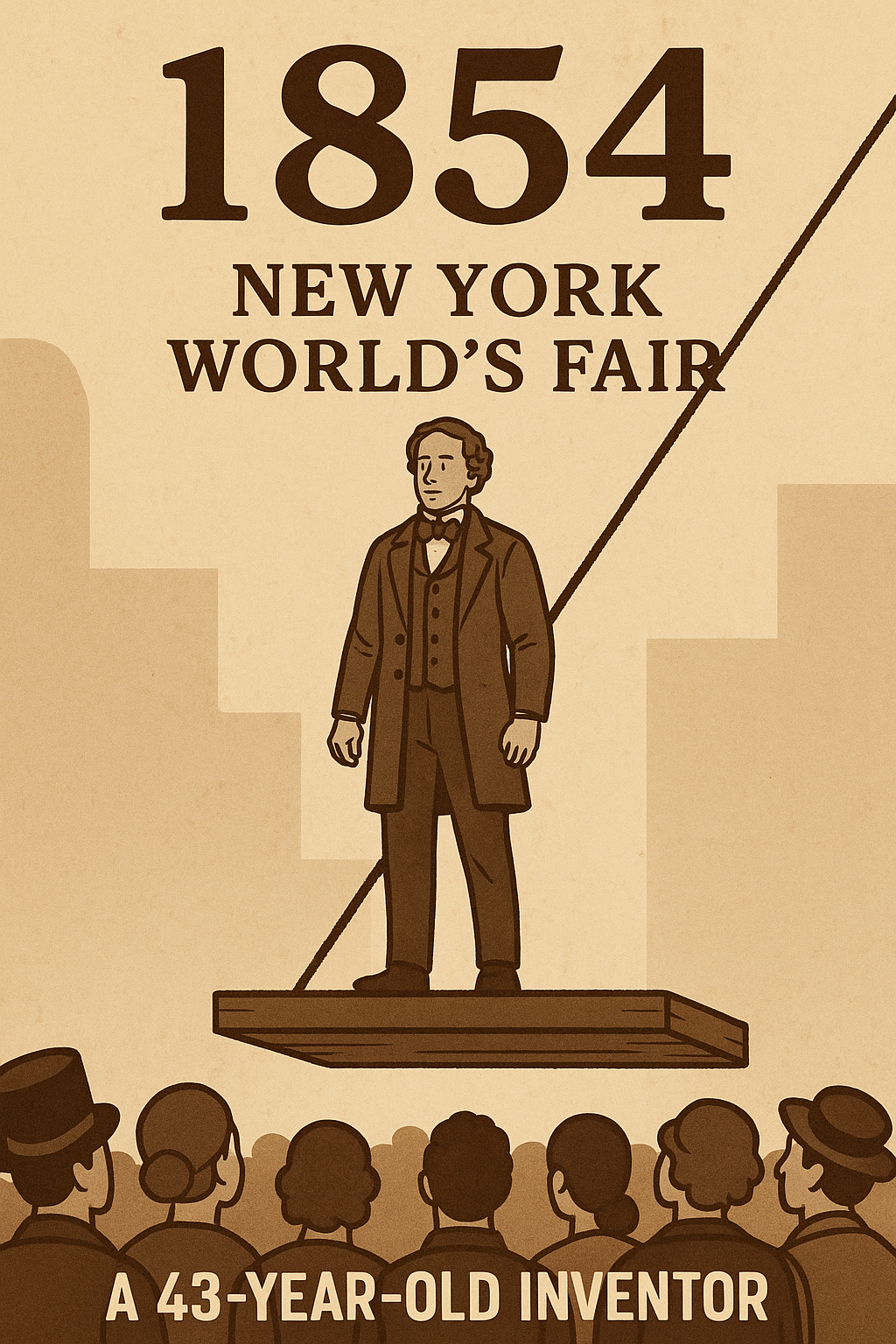
A 43-year-old inventor stood nervously atop a wooden platform, suspended high above the ground. Before him, a crowd had gathered at the Crystal Palace during the New York World’s Fair of 1854. His name was Elisha Otis—a mechanic and inventor who had spent years working in industries like carriage manufacturing and mill equipment.
Little did anyone know that this summer day would mark a turning point in architectural history—one that would change how we design cities forever.
The setup seemed simple: a wooden platform hoisted high in the air. The crowd watched in confusion. Elevators weren’t new, after all. So why this dramatic display?
What many in the audience didn’t realize was that while elevators had existed for centuries—even as far back as the 3rd century BC, used by Archimedes and later by the Romans to lift gladiators and animals into the Colosseum arena—none had a reliable safety feature. One snapped rope meant disaster.
As the crowd murmured in anticipation, Otis gave the signal.
His assistant stepped forward and cut the rope suspending the platform.
Gasps echoed through the hall. The platform—and Otis—began to drop.
But only for a moment.
With a sudden jolt, the platform came to a stop midair. The crowd froze. Then Otis turned to them calmly and declared:
“All safe, gentlemen! All safe.”
That was the moment the modern passenger elevator was born.
While Otis’s elevator looked much like the cargo hoists of the time—simple platforms lifted by ropes—it included one revolutionary addition: a safety mechanism. If the rope failed, the elevator wouldn’t crash. Instead, a spring-loaded ratchet system with pivot arms and grooved teeth on the shaft walls would engage, halting the fall.
This simple but brilliant invention made it possible to transport people—not just freight—vertically. And it opened the door to skyscrapers, urban high-rises, and eventually marvels like the Burj Khalifa.
Modern elevators have dozens of safety features today, but the first—and arguably most important—was demonstrated that day in 1854, at what was officially called the Exhibition of the Industry of All Nations.
Otis later founded his own company—OTIS—a name we still see in elevators and escalators around the world. Though the safety elevator was publicly demonstrated in 1854, the first passenger elevator wasn’t actually installed until 1857, in a New York department store.
Fun Fact: Today, the Otis company helps over 2 billion people move vertically every day!